
Rear-end collisions look straightforward until the insurer starts asking questions about your speed, your following distance, and what you were doing in the seconds before impact.
Most people assume that if a car hits you from behind, the driver behind you is responsible. That assumption is usually correct, but not always. Colorado’s modified comparative negligence rule means that fault is not automatically 100 percent on the trailing driver, and insurance companies know how to find reasons to share it. Working with a Colorado car accident lawyer before making any statements to an adjuster gives you a much clearer picture of where you actually stand before the insurer starts building their version of the crash.
Four situations where rear-end fault becomes complicated
- Sudden stops without a mechanical reason, particularly on high-speed roads like I-25 where insurers argue the stop was unreasonable
- Brake lights that were not functioning at the time of impact, reducing the trailing driver’s ability to react
- Multi-vehicle chain collisions where one impact pushes a vehicle into another and liability spreads across multiple drivers
- Commercial truck rear-end crashes where federal following distance regulations, driver hours, and brake maintenance records become part of the liability picture
What Colorado law says about following distance
The reasonable and prudent standard
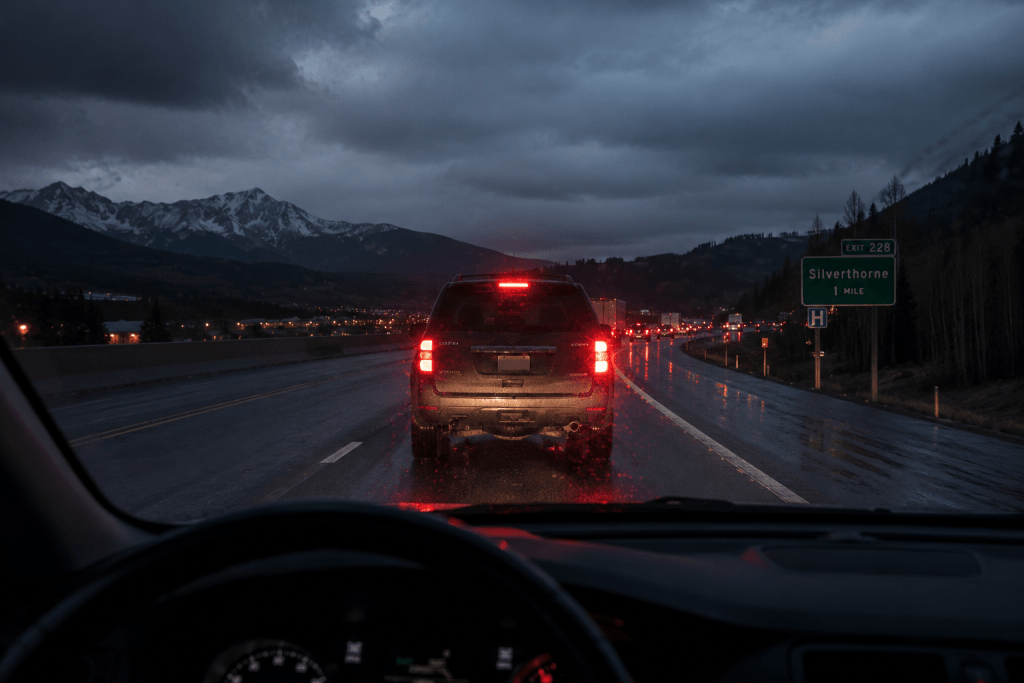
Colorado’s following distance statute, C.R.S. 42-4-1008, requires drivers to maintain a distance that is reasonable and prudent given the speed of traffic and road conditions. There is no fixed number of feet. That flexibility cuts both ways. A trailing driver who rear-ends someone cannot simply claim they were maintaining a reasonable distance if the physical evidence shows otherwise. But it also means that an injured front-vehicle driver may face questions about whether their own conduct – lane changes, abrupt braking, or merging – contributed to the crash.
When the rear vehicle is a commercial truck, the Federal Motor Carrier Safety Administration’s following distance requirements add another layer. Truck drivers operating on highways are held to specific standards around following distance based on vehicle speed and load weight, and violations of those standards become significant evidence in a civil claim. The FMCSA regulations page outlines the full framework that applies to commercial vehicle operators on Colorado roads.
How modified comparative negligence applies
Under C.R.S. 13-21-111, if you are found to bear 20 percent of the fault for a rear-end collision – say, for a sudden lane change that gave the driver behind you no time to react – your damages are reduced by 20 percent. If you are found 50 percent or more at fault, you recover nothing. Insurance companies frequently build arguments around the front driver’s conduct because even a partial fault attribution meaningfully reduces what the insurer has to pay out.
Why whiplash and soft-tissue injuries make these cases harder
Rear-end collisions are the most common cause of whiplash injuries, and whiplash is one of the most contested injury types in all of personal injury litigation. Insurers routinely argue that soft-tissue injuries are exaggerated, pre-existing, or inconsistent with the speed of impact. They will request all prior medical records looking for any history of neck or back complaints. They will point to low-speed crash physics to argue that the impact could not have caused the claimed level of injury.
The NHTSA rear-end crash data consistently shows that soft-tissue injury at moderate speeds is well-documented and medically expected, which matters when an insurer argues the impact was too minor to cause harm. Countering these arguments requires consistent, well-documented medical treatment from shortly after the crash, imaging where appropriate, and sometimes expert testimony on the biomechanics of low-speed impacts. Gaps in treatment, delayed doctor visits, or inconsistency between reported symptoms and observable activity are the points insurers will exploit most aggressively.
What to do when the crash involves a commercial vehicle
Rear-end crashes involving trucks are a distinct category. The injuries are typically more severe, the evidence is broader, and the liable parties may extend beyond the driver to include the trucking company, a maintenance contractor, or a cargo loader. Truck drivers operating in violation of hours-of-service limits at the time of a rear-end crash – fatigued and with slowed reaction times – represent one of the most significant liability scenarios in commercial vehicle litigation. Evidence like electronic logging device data and black box recordings can be overwritten within weeks, making early legal action essential.
- Request a police report immediately and note whether the officer cited the rear driver for following too closely or any other infraction
- Photograph the damage pattern on both vehicles, which helps establish the angle, speed, and nature of the impact
- If a commercial truck was involved, contact an attorney before the trucking company’s own investigators arrive at the scene
Match the strategy to the right fit
The right approach to a rear-end collision claim depends on what the insurer is actually disputing and what the evidence shows.
- If the other driver was in a commercial vehicle, reviewing your options with a Colorado truck accident attorney is the right starting point
- If the dispute centers on injury severity or the insurer is arguing your injuries are unrelated to the crash, medical documentation and consistent treatment records are the most important tools you have
Final checklist before you act
- Get medical attention the same day, even if pain is mild – delayed onset symptoms are common in rear-end crashes and need to be documented early
- Photograph damage to both vehicles, roadway conditions, and any visible injuries before leaving the scene
- Do not speculate about speed, stopping distance, or fault in conversations with adjusters before reviewing the police report
- If a truck was involved, contact an attorney immediately to ensure evidence preservation letters are sent before data is lost
Rear-end crashes in Colorado are frequently treated as open-and-shut cases when they are not. The trailing driver’s presumed fault can be contested, shared fault arguments can reduce your recovery, and the insurer’s early offer rarely reflects the full cost of treatment, lost income, and lasting injury. Getting an accurate picture of your claim early is the most reliable way to protect the outcome.


