
Distracted Driving Accidents in Colorado: Proving the Other Driver Was on Their Phone
Distracted driving is one of the leading causes of vehicle crashes in Colorado, and phone use while driving is the most common and most documented form. When a driver who was texting or scrolling causes a crash, the injured person typically knows what happened but has no direct proof – the phone goes into a pocket before the police arrive and the driver says nothing. A Colorado car accident lawyer understands the discovery tools and investigation strategies that can surface that evidence, and knows what needs to happen quickly to make sure it does not disappear.
What Colorado law says about phone use while driving
Colorado’s mobile device law was updated effective January 1, 2025 under C.R.S. 42-4-239. The updated statute prohibits drivers from physically holding a mobile electronic device, watching video content, or writing, sending, or reading text-based communication while operating a vehicle. The previous version of the law was more limited. The current law covers a broader range of phone use and applies to all drivers, not just those under 18.
A driver who violated C.R.S. 42-4-239 at the time of a crash can be found negligent per se – meaning the statutory violation itself establishes the breach of duty without requiring further argument about whether the conduct was unreasonable. That makes proving the phone use particularly valuable from a liability standpoint, not just as additional evidence of carelessness but as a direct route to establishing fault.
How distracted driving accidents tend to look on the road
- Rear-end crashes where the driver shows no sign of braking before impact, suggesting they were not watching the road
- Drifting across lane markings, running red lights, or failing to stop at controlled intersections
- Delayed reaction times that are inconsistent with the driver’s claimed awareness of road conditions
- Crash patterns where the driver’s speed and direction do not change at all before impact, indicating complete inattention
These behavioral patterns alone do not prove phone use, but they are the starting point for an investigation that looks for corroborating evidence of distraction at the time of the crash.
The evidence sources that can prove phone use
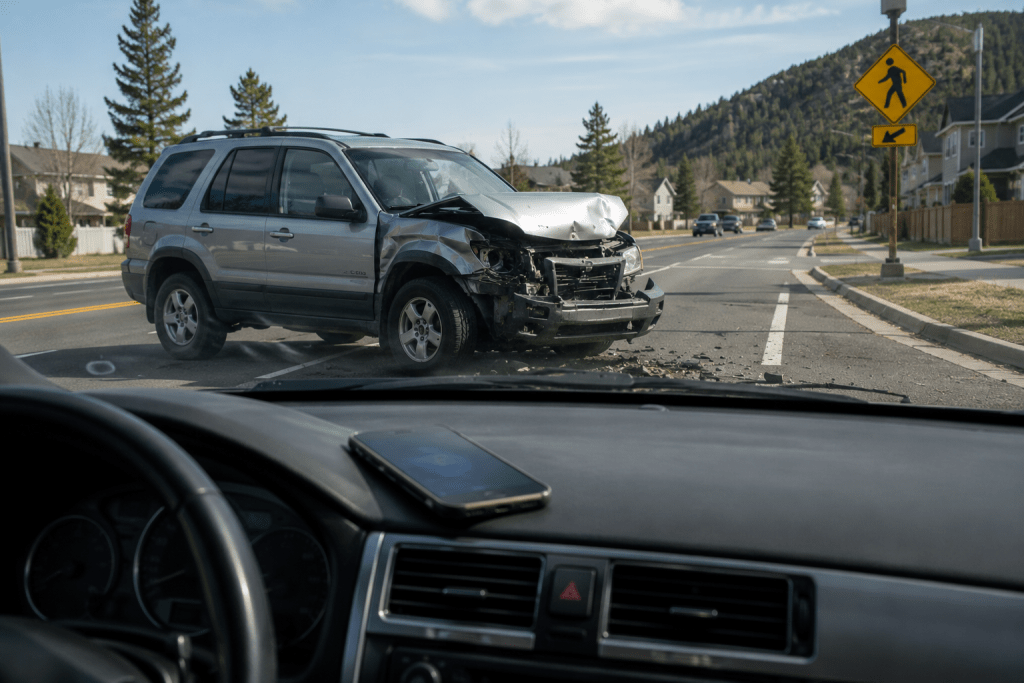
Cell phone records
Phone records subpoenaed from the carrier can show calls, texts, and data activity timestamped to the minutes before and during the crash. If the records show active text or data use at the time of impact, that is powerful evidence of distraction. Obtaining these records requires formal legal process – carriers do not produce them voluntarily – and the request needs to happen while the records are still retained. Most carriers retain detailed activity logs for 12 to 18 months depending on the type of record. Acting early matters.
Dashcam and traffic camera footage
Cameras on the crashing vehicle, on your own vehicle, or at a nearby intersection may have captured the driver looking down, holding a phone, or exhibiting the physical posture of someone engaged with a device. This footage is time-sensitive. Traffic camera recordings in Colorado are typically retained for only a short period before being overwritten, and business surveillance systems vary widely in their retention policies. An attorney who sends preservation letters immediately after a crash creates a legal obligation to retain that footage before it is gone.
The driver’s own statements and social media
Drivers who were on their phones at the time of a crash sometimes make statements at the scene or post to social media that are inconsistent with claims of attentiveness. Even a post made shortly after the crash showing the driver active on their phone creates a timeline that an attorney can use. Social media monitoring and preservation of the driver’s online activity in the days surrounding the crash is a standard part of distracted driving case investigation.
Vehicle data and event data recorders
Many modern vehicles record speed, braking activity, steering input, and other driving data in an event data recorder that preserves the seconds before a crash. A vehicle that shows no braking input at all before a rear-end collision is strong evidence that the driver was not watching the road. Some newer vehicles also sync with mobile devices and retain connection logs that can show when the phone was actively in use.
What makes distracted driving cases harder to prove
The main challenge is that phone use is self-contained – without the phone records or camera footage, there may be no direct evidence beyond your own account of what you observed. Drivers rarely admit to phone use, and the police report may not reflect it unless an officer at the scene made a specific observation. In cases where there are no witnesses and no footage, the circumstantial case built from the crash pattern, the vehicle data, and ultimately the phone records becomes the foundation of the liability argument.
The NHTSA distracted driving data shows that in recent years over 3,000 people are killed annually in distraction-affected crashes nationwide, and that phone use is the dominant form of driver distraction. That documented scale supports the plausibility of distraction as a cause in any crash where the behavioral indicators are present.
Match the strategy to the right fit
Distracted driving cases require early, aggressive evidence gathering. The strategy depends on what evidence is realistically available given the facts of the specific crash.
- If there is dashcam footage or a witness who observed the driver looking at a phone, that evidence needs to be preserved and documented immediately
- If the crash involved a commercial vehicle, the driver’s employer communications and company-issued device records may also be relevant and are subject to their own preservation obligations under FMCSA rules – reviewing that with a Colorado truck accident attorney is worth doing early
Final checklist before you act
- Note and document any observations about the other driver’s behavior at the scene – looking down, delayed reaction, phone in hand – before they leave
- Identify any cameras in the area that may have captured the crash and the driver’s behavior before it occurred
- Contact an attorney quickly so preservation letters can go to the carrier, any camera operators, and the at-fault driver before evidence is lost
- Do not give a recorded statement to any insurer about your observations until you have spoken with an attorney about how your account fits the overall evidence picture
Distracted driving cases in Colorado are winnable when the evidence is gathered quickly and the right tools are used to surface what actually happened. Phone records, camera footage, vehicle data, and behavioral evidence all tell parts of the same story. Putting those pieces together before they disappear is the most important thing that happens in the early days of these cases.


